

We live in an age characterized by an exhaustion epidemic. If you find yourself hitting the snooze button repeatedly, relying on multiple cups of coffee to drag yourself through the afternoon, and collapsing on the couch the moment you get home, you are not alone. While occasionally feeling tired after a late night or a grueling workout is a normal physiological response, experiencing relentless, heavy, unresolving exhaustion is not.
Constant fatigue is one of the most common complaints heard by primary care physicians, yet it remains one of the most complex symptoms to diagnose. Unlike a broken bone or a specific bacterial infection, fatigue is entirely subjective and non-specific. It acts as a warning light on your body’s dashboard, indicating that something under the hood is not functioning optimally.
Many people blame their exhaustion on their busy lifestyles, writing it off as the inevitable cost of modern living. However, when sleep does not cure your tiredness, it is time to look deeper. The root cause of your chronic fatigue might be hiding in plain sight, masked by common misconceptions or subtle biological shifts that standard annual check-ups might miss.
This comprehensive guide delves into the deep, often-overlooked medical, psychological, and physiological reasons behind persistent tiredness. By understanding these nine hidden causes of constant fatigue, you can transition from merely surviving your days to actively reclaiming your energy and vitality.
Understanding the Difference: Tiredness vs. Chronic Fatigue
Before exploring the hidden causes, it is critical to distinguish between ordinary tiredness and pathological fatigue. The distinction lies in the severity, duration, and response to rest.
Table 1: Differentiating Normal Tiredness vs. Constant Fatigue
| Feature | Normal Tiredness | Constant / Chronic Fatigue |
| Primary Trigger | Physical exertion, missed sleep, acute stress. | Often unprovoked, or disproportionate to exertion. |
| Response to Rest | Resolves entirely after adequate sleep/rest. | Persists despite getting 8+ hours of quality sleep. |
| Physical Sensation | Feeling sleepy, heavy eyes, desire to lie down. | Heavy limbs (leaden paralysis), brain fog, weakness. |
| Duration | Acute (a few days to a week). | Chronic (lasting for weeks, months, or even years). |
| Impact on Life | Mildly inconvenient, but manageable. | Debilitating; interferes with work, social life, and health. |
If your symptoms align more closely with the right column, it is time to investigate the following nine hidden causes of constant fatigue.
1. Undiagnosed Sleep-Disordered Breathing (Sleep Apnea)
When most people think of Sleep Apnea, they picture an older, significantly overweight individual snoring loudly. Because of this stereotype, millions of people—including young, fit individuals and women—suffer from sleep-disordered breathing without ever knowing it.
Obstructive Sleep Apnea (OSA) occurs when the muscles in the back of your throat relax too much during sleep, causing your airway to narrow or close completely. This briefly cuts off your oxygen supply. Your brain senses this life-threatening hypoxia (low oxygen) and jolts you out of deep sleep into a lighter stage of sleep to reopen your airway.
This micro-awakening happens so quickly that you usually do not remember it, but it can occur dozens or even hundreds of times a night. As a result, your body is completely deprived of the restorative REM (Rapid Eye Movement) and deep slow-wave sleep phases required for cellular repair, memory consolidation, and energy restoration.
The Hidden Signs:
You might not snore. Instead, you might grind your teeth (bruxism), wake up with a dry mouth or a mild headache, or experience brain fog throughout the morning. Upper Airway Resistance Syndrome (UARS), a milder cousin of sleep apnea, is particularly common in young women and is notorious for causing profound daytime fatigue without classical snoring.
What the Science Says:
According to the National Heart, Lung, and Blood Institute (NHLBI), untreated sleep apnea not only causes severe daytime fatigue but dramatically increases the risk of cardiovascular disease, hypertension, and insulin resistance due to the constant nocturnal surges of adrenaline and cortisol caused by choking for air.
2. Subclinical Thyroid Dysfunction
Your thyroid is a small, butterfly-shaped gland located at the base of your neck. It acts as the master conductor of your body’s metabolism. It produces hormones (primarily T3 and T4) that dictate how efficiently every single cell in your body converts oxygen and calories into usable energy (ATP).
When your thyroid is underactive—a condition known as Hypothyroidism—your cellular engines essentially slow down to a crawl. The most common cause of this in the developed world is Hashimoto’s thyroiditis, an autoimmune condition where the immune system mistakenly attacks the thyroid gland.
The “Hidden” Aspect:
Why is this a hidden cause? Because the standard medical threshold for diagnosing thyroid issues is often too broad. Most doctors only test TSH (Thyroid Stimulating Hormone). If your TSH falls within the “normal” reference range (usually 0.4 to 4.0 mIU/L), you are told your thyroid is fine. However, many integrative endocrinologists argue that optimal TSH is between 0.5 and 2.0 mIU/L. If your TSH is 3.8, you are technically “normal,” but you might be experiencing subclinical hypothyroidism, feeling perpetually cold, sluggish, and exhausted.
Furthermore, a TSH test does not measure the active thyroid hormone (Free T3) or thyroid antibodies. Your body might be struggling to convert inactive T4 into active T3, leaving your cells starved for metabolic instruction despite normal TSH levels.
Symptoms Beyond Fatigue:
Unexplained weight gain, hair loss (especially the outer third of the eyebrows), dry skin, constipation, and a heightened sensitivity to cold are hallmark signs of sluggish thyroid function.
3. Stealth Nutritional Deficiencies
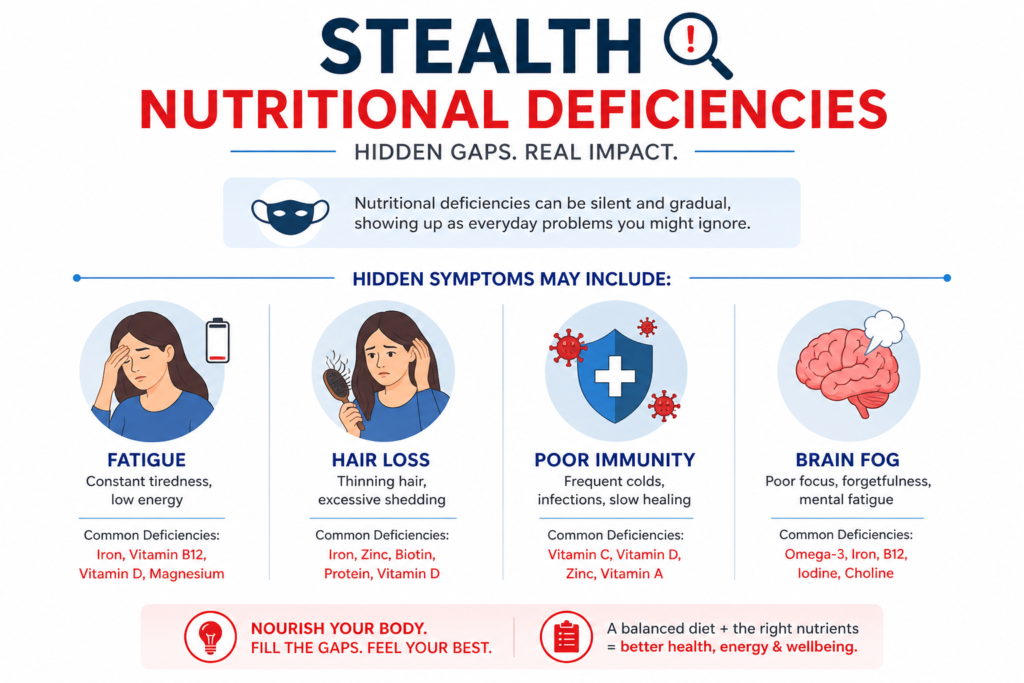
In an era of caloric abundance, we are simultaneously facing a crisis of nutritional starvation. The highly processed Western diet is notoriously devoid of the essential micronutrients required for mitochondrial energy production. Even if you eat a relatively healthy diet, issues like poor soil quality and gastrointestinal malabsorption can leave you deficient.
Table 2: Common Micronutrient Deficiencies Linked to Fatigue
| Nutrient | Role in Energy Production | Signs of Deficiency Beyond Fatigue |
| Iron / Ferritin | Carries oxygen in red blood cells. | Pale skin, shortness of breath, cold hands/feet, brittle nails. |
| Vitamin B12 | DNA synthesis, nerve health, red blood cell formation. | Numbness/tingling in extremities, brain fog, mood changes. |
| Vitamin D | Immune regulation, muscle function, bone health. | Bone pain, frequent infections, seasonal depression. |
| Magnesium | Crucial for the synthesis of ATP (cellular energy). | Muscle cramps, eye twitches, insomnia, anxiety. |
The “Hidden” Aspect:
Iron deficiency is a classic example of hidden fatigue. Most standard blood panels test Hemoglobin to check for anemia. However, you can have totally normal Hemoglobin but severely depleted Ferritin (your body’s iron storage protein). Without testing Ferritin, absolute iron deficiency without anemia (IDWA) is frequently missed, leaving patients exhausted without a diagnosis. The World Health Organization recognizes iron deficiency as the most common nutritional disorder worldwide.
Similarly, Vitamin B12 deficiency is common not just in vegans and vegetarians, but in older adults and those taking antacids (like Omeprazole), which suppress the stomach acid required to extract B12 from food.
4. Blood Sugar Rollercoasters and Insulin Resistance
You do not need to be diagnosed with diabetes to suffer the fatiguing consequences of blood sugar dysregulation. When you consume a meal high in refined carbohydrates and low in fiber, protein, or healthy fats, your blood glucose spikes rapidly. In response, your pancreas pumps out a massive wave of insulin to shuttle that toxic excess glucose out of your bloodstream and into your cells.
This overcompensation often results in reactive hypoglycemia—a sharp crash in blood sugar occurring 90 to 120 minutes after eating. This crash triggers an intense wave of fatigue, brain fog, and sugar cravings.
The “Hidden” Aspect: Insulin Resistance
Over time, if you subject your body to constant glucose spikes, your cells stop listening to insulin. This is called Insulin Resistance. Because the cells are ignoring the insulin, glucose cannot enter the cells to be burned for energy. Paradoxically, your bloodstream is swimming in energy (glucose), but your cells are starving, leading to relentless lethargy.
The Symptoms:
Experiencing profound mid-afternoon energy slumps (the “post-lunch coma”), waking up tired even after a full night’s sleep, carrying excess weight around the abdominal region, and experiencing hanger (anger caused by hunger) are strong indicators of blood glucose dysregulation. A standard fasting glucose test might look normal for years while fasting insulin levels silently climb.
5. Intestinal Permeability and Gut Dysbiosis
Hippocrates famously stated that “all disease begins in the gut,” and modern science is increasingly validating this ancient wisdom. Your gastrointestinal tract is home to trillions of bacteria, fungi, and viruses, collectively known as the gut microbiome. These microbes are not just passengers; they actively produce vitamins, synthesize neurotransmitters (like serotonin and dopamine), and regulate your immune system.
The Mechanism of Fatigue:
When the balance of good to bad bacteria is disrupted (due to antibiotics, chronic stress, artificial sweeteners, or a low-fiber diet), it leads to a state called dysbiosis. Dysbiosis can cause the tight junctions lining your intestinal wall to loosen, resulting in “Leaky Gut Syndrome” (increased intestinal permeability).
When the gut barrier is compromised, undigested food particles, bacterial toxins (like lipopolysaccharides or LPS), and pathogens leak into your bloodstream. Your immune system recognizes these as foreign invaders and mounts a systemic inflammatory response.
According to research published in the National Institutes of Health (NIH), this systemic low-grade inflammation causes immune cells to release cytokines. These inflammatory cytokines travel to the brain, crossing the blood-brain barrier and inducing what neuroscientists call “sickness behavior.” Sickness behavior is the body’s evolutionary response to infection, characterized by profound lethargy, apathy, and a desire to isolate—all symptoms indistinguishable from constant fatigue.
6. HPA Axis Dysfunction (Chronic Stress Response)
For years, the alternative health community used the term “Adrenal Fatigue” to describe a state where the adrenal glands were supposedly “burnt out” and could no longer produce cortisol. Mainstream endocrinologists rightly pushed back, noting that the adrenal glands do not simply run out of hormones unless a patient has Addison’s disease (a severe autoimmune condition).
However, the symptoms of what people called adrenal fatigue are incredibly real. The medically accurate term is Hypothalamic-Pituitary-Adrenal (HPA) Axis Dysfunction.
The Science of Stress and Fatigue:
Your HPA axis is the communication highway between your brain (hypothalamus and pituitary) and your adrenal glands. When you encounter a stressor, this axis triggers the release of cortisol and adrenaline, initiating the “fight or flight” response. This system evolved to save us from acute, physical dangers—like running from a predator.
In the modern world, our stressors are chronic and psychological: toxic work environments, financial worries, doom-scrolling on social media, and relationship struggles. The brain cannot distinguish between a physical threat and a psychological one, so the HPA axis remains perpetually activated.
Eventually, the brain’s receptor sites become blunted to the constant wash of cortisol. To protect the body from the toxic effects of chronic stress hormones, the hypothalamus downregulates the signal. The result is a flattened diurnal cortisol curve. Instead of a healthy spike of cortisol in the morning to wake you up, your cortisol is low when you need it (morning) and high when you don’t (late at night, causing wired-and-tired insomnia). This biological burnout leaves you feeling utterly drained from the moment you open your eyes.
7. Latent Infections and Post-Viral Fatigue
The medical community has long recognized that certain viral and bacterial infections can leave a lasting imprint on the immune system, causing fatigue that persists long after the acute infection has cleared. This phenomenon gained global recognition with the advent of Long COVID, but post-viral fatigue has existed for centuries.
The Culprits:
- Epstein-Barr Virus (EBV): The virus responsible for mononucleosis (“mono”). Up to 90% of adults have been infected with EBV. While the virus usually goes dormant, periods of extreme stress, trauma, or immune suppression can cause it to reactivate, triggering relentless fatigue, swollen lymph nodes, and muscle aches.
- Lyme Disease: Caused by the bacterium Borrelia burgdorferi transmitted by tick bites, chronic Lyme disease can evade the immune system and cause debilitating neurological and physical exhaustion.
- SARS-CoV-2 (Long COVID): Post-Acute Sequelae of SARS-CoV-2 (PASC) frequently presents with intense post-exertional malaise (PEM), where minor physical or mental effort triggers a massive crash in energy.
The “Hidden” Aspect:
Routine bloodwork does not check for dormant viral reactivation or the micro-clotting and endothelial dysfunction currently being studied as drivers of post-viral syndromes. Many patients with post-viral fatigue are misdiagnosed with depression because their standard labs return completely normal, despite their cells being trapped in a dysfunctional, low-energy state (often referred to as the “cell danger response”). You can read more about the systemic impacts of these conditions via the Centers for Disease Control and Prevention (CDC).
8. High-Functioning Depression and Atypical Anxiety

Mental and emotional health are intrinsically linked to physical energy levels. However, the modern manifestation of mental health struggles often does not look like the stereotypical image of depression (crying, inability to get out of bed).
Atypical Depression:
Atypical depression is characterized by mood reactivity (your mood can brighten in response to positive events), but it carries heavy physical symptoms. The most notable is “leaden paralysis”—a sensation that your arms and legs are physically weighed down by lead. Other symptoms include hypersomnia (sleeping too much but waking up exhausted) and increased appetite.
High-Functioning Anxiety:
Constant anxiety is akin to leaving your car idling with the accelerator pressed to the floor while the parking brake is on. The mental rumination, perfectionism, and constant state of hyperarousal drain massive amounts of neurological energy. The brain accounts for roughly 20% of the body’s total energy expenditure. When it is caught in an endless loop of worry and worst-case-scenario planning, it robs energy from the rest of the body.
Furthermore, anxiety actively destroys sleep architecture, preventing the deep, restorative stages of sleep, locking the individual into a vicious cycle of exhaustion breeding anxiety, and anxiety breeding exhaustion.
9. Silent Autoimmune Conditions
Autoimmune diseases occur when the immune system loses its tolerance to self-tissue and begins attacking the body’s own organs. There are over 80 recognized autoimmune diseases, and many of them incubate silently for years before causing profound organ damage. During this prodromal (early) phase, the primary—and sometimes only—symptom is debilitating fatigue.
Common Hidden Autoimmune Culprits:
- Celiac Disease: An autoimmune reaction to gluten that destroys the villi in the small intestine. You do not need severe gastrointestinal distress to have Celiac; many patients present solely with neurological symptoms, anemia, and extreme fatigue due to total nutrient malabsorption.
- Sjogren’s Syndrome: Often dismissed as just “dry eyes and dry mouth,” this systemic autoimmune disease causes profound exhaustion and joint pain.
- Lupus (SLE) and Rheumatoid Arthritis (RA): In their early stages, before the classic rashes or severe joint deformities appear, the systemic inflammation caused by circulating autoantibodies acts as a massive drain on the body’s energy reserves.
Because autoimmune diseases disproportionately affect women (roughly 80% of autoimmune patients are female), their initial complaints of fatigue are tragically frequently dismissed by medical professionals as stress, hormones, or psychosomatic issues.
A Roadmap for Recovery: Tests to Request from Your Doctor
If you resonate with the hidden causes listed above, taking action is the next step. Diagnosing the root cause of fatigue requires a collaborative approach with a healthcare provider who is willing to look beyond standard reference ranges.
When visiting your doctor, be specific about your symptoms. Instead of saying “I’m tired,” explain the impact: “I sleep nine hours a night but feel so exhausted by 2 PM that I cannot focus on my computer screen, and I am too weak to exercise.”
Table 3: Recommended Lab Tests for Unexplained Fatigue
| Category | Specific Tests to Request | Why it Matters |
| Thyroid Panel | TSH, Free T3, Free T4, TPO Antibodies, TG Antibodies. | Checks for subclinical hypothyroidism and Hashimoto’s. |
| Iron & Nutrients | Ferritin, Iron Binding Capacity, Vitamin B12, Folate, Vitamin D (25-OH), RBC Magnesium. | Identifies cellular starvation and oxygen transport issues. |
| Metabolic Health | Fasting Insulin, Hemoglobin A1c (HbA1c), Fasting Glucose. | Detects early insulin resistance before diabetes develops. |
| Inflammation / Autoimmune | High-Sensitivity C-Reactive Protein (hs-CRP), ANA (Antinuclear Antibody). | Markers for systemic inflammation and autoimmune activity. |
| Sleep Assessment | At-home sleep study or polysomnography. | Rules out Obstructive Sleep Apnea and sleep disruptions. |
(Note: Always consult with a licensed medical professional before interpreting medical tests or making dramatic changes to your health regimen.)
Conclusion: Reclaiming Your Vitality
Constant fatigue is not a life sentence, nor is it a personal failing. It is a biological alarm bell signaling that your physiological environment requires attention. Whether the root cause lies in undiagnosed sleep apnea, a stealth nutritional deficiency, a struggling thyroid, or the chronic stress of modern living, the exhaustion you feel is valid and measurable.
Do not settle for the assumption that being tired is just a normal part of aging or adult life. By understanding these nine hidden causes, advocating for comprehensive laboratory testing, and making targeted lifestyle interventions, you can uncover the specific roadblocks hindering your cellular energy production. Addressing the root cause requires patience and persistence, but the reward—a vibrant, energized, and fully engaged life—is undoubtedly worth the effort.
Scientific References and Trusted Resources
- Mayo Clinic – Hypothyroidism: Provides comprehensive data on the symptoms and hidden nature of underactive thyroid conditions.
- National Institutes of Health (NIH) – The Gut-Brain Axis and Fatigue: Studies detailing how intestinal permeability and gut dysbiosis contribute to systemic inflammation and neurological fatigue. Visit PubMed Central (NIH)
- World Health Organization (WHO) – Anaemia and Iron Deficiency: Global guidelines highlighting that normal hemoglobin does not rule out severe ferritin deficiency. Visit WHO
- Cleveland Clinic – Insulin Resistance: Medical explanations of how blood sugar dysregulation blocks cellular energy absorption.
- Centers for Disease Control and Prevention (CDC) – Myalgic Encephalomyelitis/Chronic Fatigue Syndrome (ME/CFS) & Post-Viral Illness: Information regarding EBV, Long COVID, and systemic exertion intolerance disease.
- Wikipedia – Obstructive Sleep Apnea: General overview of the mechanics of sleep-disordered breathing and its impact on REM sleep. Read on Wikipedia
- Wikipedia – Hypothalamic–Pituitary–Adrenal axis: Detailed physiological breakdown of the body’s stress response and hormonal regulation. Read on Wikipedia

Emily Carter is a Senior Health Researcher and Supplement Analyst at the Nutrasfit Research Team, based in Austin, Texas. She specializes in evaluating dietary supplements through ingredient analysis, scientific research, and real-world effectiveness.
With a background in nutrition science, Emily focuses on breaking down complex health information into simple, practical insights that readers can trust. Her work is centered on helping individuals make informed decisions and choose supplements that are safe, effective, and aligned with their health goals.